

How to Choose the Right Aluminum Circle for Deep Drawing
Deep drawing is a common metal forming process, widely used in kitchenware, home appliances, automotive parts, packaging containers, and other fields. Aluminum discs, as the core substrate for deep drawing, directly determine forming efficiency, product quality, and production costs.
Many industry professionals easily fall into the trap of "only looking at the price" or "choosing any alloy" when selecting alloys, leading to problems such as cracking, wrinkling, and dimensional deviations during deep drawing, thus increasing rework costs. So how should one choose?
Core Prerequisites: Before selecting aluminum discs, don't rush to look at the alloy type. First, clarify two core prerequisites to significantly narrow down the selection range and avoid blind attempts: First, the difficulty of deep drawing, i.e., the forming depth and workpiece complexity (whether there are complex curves or grooves); second, the product application, such as whether it comes into contact with food, whether corrosion resistance is required, and whether strength requirements exist.
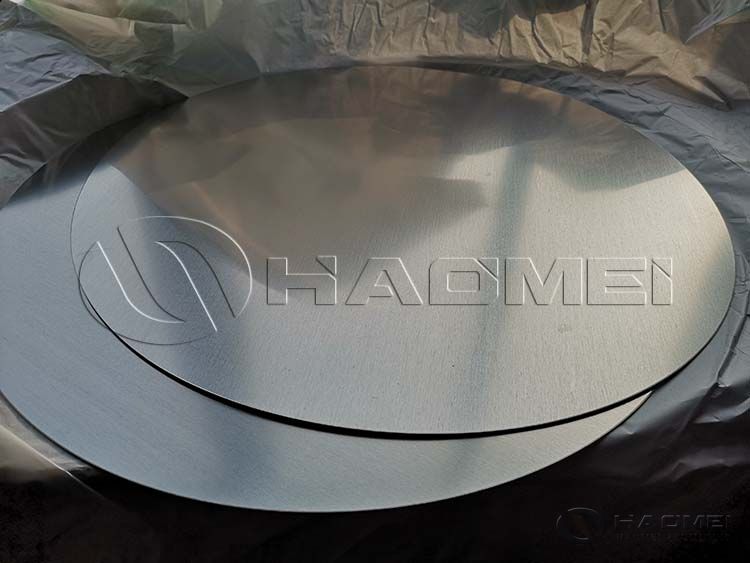
In addition, a key performance requirement for aluminum discs used in deep drawing is excellent ductility and uniform microstructure. At the same time, it is necessary to control the earing rate and ensure uniform thickness. This is also the core basis for subsequent alloy selection and custom processing, meeting the relevant technical standards for aluminum and aluminum alloy sheets and strips used in deep drawing.
Different Alloy Aluminum Discs
The most commonly used aluminum disc alloys for deep drawing are mainly 1-series, 3-series, and 5-series, with 8-series used in a few applications. Different alloys vary significantly in composition, ductility, strength, and corrosion resistance. Selection must be based on specific needs to avoid using oversized materials or under-selecting materials.
1. 1-Series Aluminum Discs (1050, 1060, 1100)
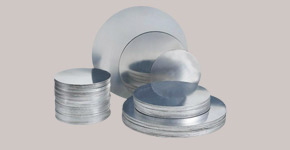
1-series aluminum belongs to the pure aluminum series, with an aluminum content of over 99%. 1050, 1060, and 1100 are the most commonly used models in deep drawing, with aluminum circle 1060 being the most widely used. Its core advantages are excellent ductility and plasticity; elongation in the O-state (annealed state) can reach over 30%, allowing it to withstand large deep drawing deformations.
It is not prone to cracking or wrinkling, and has a smooth surface, making it easy to perform subsequent anodizing and spraying treatments. It meets food contact safety requirements, and its price is relatively affordable, making it the most cost-effective entry-level choice.
Applicable Scenarios: Shallow to medium depth deep-drawing parts, where high strength and corrosion resistance are not required, such as lamp shades, small kitchen utensils (aluminum pot liners), decorative deep-drawing parts, and ordinary signs. It is also the preferred material for many companies trying deep-drawing for the first time. It should be noted that 1-series aluminum has relatively low strength and is not suitable for products with excessively deep drawing depths, those requiring load-bearing capacity, or those exposed to harsh environments for extended periods.
2. 3-Series Aluminum Discs (3003, 3004, 3104)
3-series aluminum is an aluminum-manganese alloy, with manganese added to pure aluminum. Compared to 1-series aluminum, it has higher strength and better corrosion resistance while retaining good ductility. It offers stable deep-drawing performance, low earing rate, high dimensional accuracy of formed parts, and is not easily deformed.
It also possesses excellent weldability, meeting the core technical requirements for deep-drawing aluminum sheets. 3003 is the most widely used, while 3004 and 3104 are more suitable for medium depth deep drawing, with slightly higher strength than 3003.
Applicable scenarios: industrial containers, radiator shells, kitchen utensils (non-stick pan linings, rice cooker inner pots), aluminum can bodies, battery shell materials, etc., especially in deep drawing scenarios that require contact with water vapor, slightly acidic or alkaline environments, or have certain requirements for workpiece strength. 3-series aluminum discs are the preferred choice that balances performance and cost, and are also one of the most widely used alloy series in industrial deep drawing.
3. 5-series aluminum discs (5052, 5083)
5-series aluminum belongs to aluminum-magnesium alloys with added magnesium. It is the series with the best strength and corrosion resistance among aluminum discs for deep drawing. Its ductility can also meet the needs of complex deep drawing. It can withstand a large amount of deformation. After forming, the workpiece has high hardness and is not easily damaged. It can adapt to the harsh requirements of marine environments and automotive parts.
Some models can also be used for products with high strength requirements, such as high-pressure aluminum kettles. Among them, 5052 is suitable for medium-depth deep drawing, and 5083 is suitable for complex deep drawing parts with greater depth and higher strength requirements.
Applicable Scenarios: Automotive parts (fuel tanks, battery casings, small body parts), marine products (boat parts), high-pressure vessels, high-end kitchenware, outdoor products, etc., especially suitable for deep drawing depths, complex workpiece shapes, and long-term exposure to humid and corrosive environments. Note that 5-series aluminum is relatively expensive; if high strength and corrosion resistance are not required, it should not be chosen blindly.
4. 8-Series Aluminum Discs (8011)
8-series aluminum (mainly 8011) belongs to the aluminum foil alloy family. It is relatively thin, has excellent ductility, and is suitable for ultra-thin deep-drawn parts. It emphasizes lightweight and low cost, high surface flatness, and is not prone to wrinkling after forming. It is mainly used in food packaging, pharmaceutical packaging, and other lightweight deep-drawing applications, and is a commonly used material in the packaging industry.
Applicable Scenarios: Food packaging foil, pharmaceutical packaging, ultra-thin signs, etc. Suitable only for shallow deep drawing; not suitable for heavy-duty or complex-shaped workpieces.
Our Customization and Services
Choosing the right alloy is only the first step. High-quality aluminum discs also require customization based on deep-drawing processes and product dimensions to maximize alloy performance and minimize processing losses. As an aluminum circle supplier, we have been deeply involved in the aluminum processing industry for many years, boasting an annual production capacity of 250,000 tons.
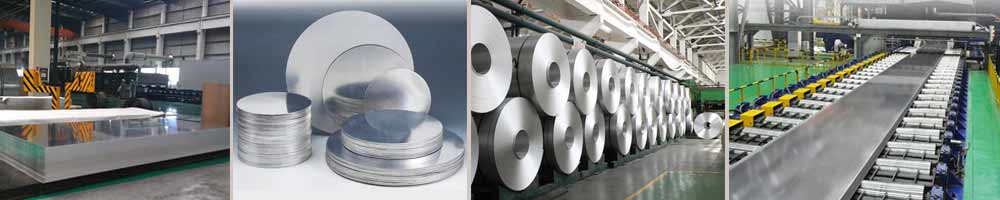
Equipped with multiple casting and rolling, cold-rolling production lines and supporting annealing and shearing equipment, we provide full-process customization services, from raw materials to finished products, offering a one-stop service to solve your pain points in selection, processing, and after-sales service. We have served nearly 5,000 clients across multiple industries.
1. Full-Specification Alloy Customization
We can provide customization of the full range of deep-drawing aluminum discs, including 1-series (1050, 1060, 1100), 3-series (3003, 3004, 3104), 5-series (5052, 5083), and 8-series (8011). We strictly select virgin aluminum ingots for processing to ensure material purity and performance stability.
Both standard and non-standard sizes can be customized to meet specific needs: thicknesses range from 0.15mm to 6.0mm, and diameters from 80mm to 1900mm. Tolerances can be precisely controlled (thickness tolerance ±0.15mm, diameter tolerance ±1mm) to satisfy different deep-drawing depths and workpiece sizes, avoiding processing losses due to dimensional inconsistencies.
2. One-stop Service
We offer customized processing techniques to optimize the deep-drawing performance of aluminum discs, catering to varying levels of deep-drawing difficulty: Firstly, we offer customized processing conditions, providing aluminum discs in different states such as O-state (annealed state, optimal ductility, suitable for complex deep-drawing) and H24 (semi-hard state, suitable for medium-deformation deep-drawing). Precise annealing (heating and holding at 350-410℃) enhances the ductility of the aluminum discs and reduces the risk of cracking during deep-drawing.
Secondly, we offer customized surface treatments, including polishing, pickling, and coating, to prevent scratches and oxidation during deep-drawing and improve the adhesion of subsequent surface treatments.
Thirdly, we offer customized forming processes, employing different forming methods such as stamping and laser cutting depending on order size. Large-scale orders prioritize efficiency, while small-batch, high-precision orders prioritize accuracy, balancing both efficiency and quality.
Original source: https://www.hm-alu.com/a/how-to-choose-the-right-aluminum-circle-for-deep-drawing.html