

Complete Alloy Guide for Aluminium Slugs: 1050,1060,1070,3003,3105
In the aluminum processing industry, the alloy grade of aluminum slugs directly determines the mechanical properties, processability, corrosion resistance and application adaptability of finished products. Proper alloy selection is essential for quality control and cost management in stamping, thermal and electrical conduction, architectural decoration and outdoor industrial applications.
I. 1000-Series Pure Aluminum slugs
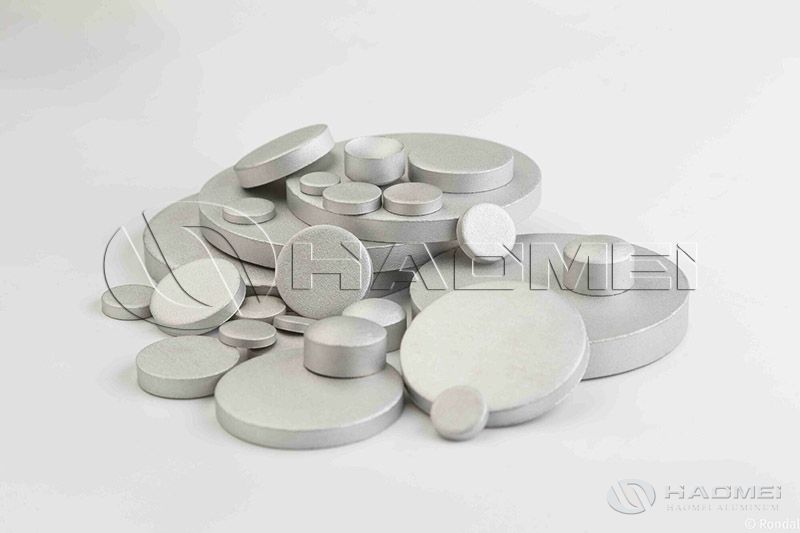
1050, 1060 and 1070 are mainstream industrial pure aluminum grades with aluminum content above 99.5% and simple compositions. They share excellent thermal and electrical conductivity, plasticity, corrosion resistance and weldability, but feature low strength, limiting their use in high-load structural scenarios. The three grades differ mainly in aluminum purity, performance details and machining precision, meeting diverse basic processing needs.
1. 1050 Aluminum slug
With ≧99.5% aluminum content, 1050 aluminium slug is the most cost-effective grade in the 1000 series. It boasts outstanding plasticity for bending, deep drawing, stamping and other standard forming processes, along with stable welding performance and atmospheric corrosion resistance, satisfying general industrial processing demands.
Restricted by its purity, its conductivity and mechanical strength are inferior to 1060 and 1070 grades, making it unsuitable for high-precision or high-strength applications.
It is widely used for low-cost, conventional products including decorative panels, stamped hardware, low-voltage conductive parts, simple chemical containers and common heat-dissipation substrates, ideal for mass production of basic components.
2. 1060 Aluminum slug
1060 slug has a minimum aluminum content of 99.6% and is the most widely used pure aluminum grade in industry. It features uniform internal grain structure with few impurities, delivering better conductivity, more stable elongation and tensile strength than 1050. It resists cracking and deformation during stamping and deep drawing, achieving balanced and reliable processing performance.
Versatile and cost-efficient, it applies to mid-to-high-end scenarios such as power battery flexible connectors, precision heat sinks, professional conductive components, deep-drawn cookware and lighting reflectors, serving as an optimal upgrade from 1050.
3. 1070 Aluminum Stock
1070 is the highest-purity grade among the three 1-series alloys, with aluminum content over 99.7% and extremely low impurities. It inherits pure aluminum’s excellent ductility and corrosion resistance, and achieves superior thermal and electrical conductivity. It provides fine, uniform surface finishes after anodizing, perfectly meeting high-precision surface treatment requirements.
Due to its higher cost, it is not used for general purposes. Instead, it is applied in high-standard scenarios demanding strict conductivity and surface precision, including high-end heat sinks, precision electronic conductive parts, high-purity anti-corrosion liners and optical reflectors.
II. 3-Series Rust-Proof Aluminum Stock
3003 and 3105 are typical Al-Mn rust-proof alloys. With manganese and trace magnesium added, they overcome the low strength of 1-series pure aluminum, gaining higher strength, impact resistance, wear resistance and fatigue resistance while retaining good formability and weldability. Their superior corrosion resistance makes them ideal for outdoor, humid and mildly corrosive industrial environments, widely used for structural and decorative components.
1. 3003 Aluminum Stock
3003 is a classic 3-series rust-proof aluminum alloy strengthened by manganese without magnesium addition. Its tensile strength is nearly 50% higher than 1-series pure aluminum, with greatly improved impact and deformation resistance. It excels in atmospheric and moisture corrosion resistance, and adapts well to hot and cold working.
Unhardenable by heat treatment, its hardness can only be adjusted via cold working. Cost-effective and stable, it is widely used for outdoor equipment covers, air conditioner heat dissipation parts, industrial pipes, fuel tank liners and base station protective accessories, serving as a core material for lightweight rust-proof industrial manufacturing.
2. 3105 Aluminum Stock
3105 is an upgraded 3-series alloy with trace magnesium added to the manganese base, greatly enhanced in strength, ductility and weather resistance. It is stronger than 3003, with an annealing elongation rate over 25% for excellent deep-drawing performance. Its flat, smooth surface ensures uniform anodizing and coating without color difference, and it resists outdoor UV radiation and weather corrosion well, being over 30% lighter than steel.
As a premium alternative to 3003, it is used for high-end architectural curtain walls, outdoor ceilings, venue decorative panels, traffic signs, automotive interior panels and lightweight RV parts, balancing strength, aesthetics and long-term durability for high-end mass production.
III. Core Selection Criteria for Five Aluminum Alloys
For rapid and accurate material selection, the core positioning of the five alloys is summarized as follows: 1050 for low-cost standard forming processing; 1060 for balanced performance and general precision processing; 1070 for ultra-high purity, top-tier conductivity and high-precision surface finishing; 3003 for basic anti-corrosion and conventional lightweight structural applications; 3105 for high-strength, weather-resistant high-end decoration and outdoor precision forming. Welcome to inquire aluminium slug price from us directly.
Original source: https://www.hm-alu.com/a/complete-alloy-guide-for-aluminium-slugs-10501060107030033105.html
Tags:aluminium slug