

Aluminum Strip For Transformer Winding
Transformer winding strip is not selected by alloy name alone. The highest-cost failures usually begin at the conductor edge: burrs can cut interlayer insulation, increase partial-discharge risk, and cause winding defects during tensioned coiling. For aluminum windings, specify edge condition, electrical conductivity, dimensions, and incoming inspection together.
Define the Electrical and Mechanical Requirements First
For power-transformer windings, electrical-conductor aluminum is commonly based on high-purity 1xxx-series material, particularly 1050, 1060, or 1070. The alloy selection must be tied to a guaranteed conductivity value rather than assumed from the alloy label. Alloy chemistry alone does not confirm electrical performance after processing.
The International Annealed Copper Standard, IACS, provides a comparable basis for conductivity. Annealed aluminum at approximately 61% IACS has a resistivity of about 0.02826 ohm mm²/m at 20 C, equivalent to approximately 35.4 MS/m. For the same conductor length and DC resistance, aluminum needs approximately 1.64 times the cross-sectional area of 100% IACS copper.
The resistance relationship is:
R = ρL / A
Where R is resistance, ρ is resistivity, L is conductor length, and A is cross-sectional area. This calculation should use the guaranteed 20 C resistivity and the actual finished width and thickness tolerances.
| Selection factor | Aluminum winding conductor | Procurement action |
|---|---|---|
| Electrical conductivity | Often specified as minimum % IACS or maximum resistivity | State the test temperature and acceptance limit in the purchase specification. |
| Cross-sectional area | About 1.64 times copper for equal DC resistance at 61% IACS | Recalculate winding window, current density, and terminal interfaces. |
| Density | Approximately 2,700 kg/m³ | Assess handling and total winding mass; aluminum is about 30% of copper density. |
| Temper | Soft annealed condition is common for winding | Define temper and minimum bend performance instead of using hardness alone. |
| Surface | Clean, dry, uniform, and free of harmful residues | Require no rolling-oil residue that can affect insulation or welding. |
IEC 60076 covers power-transformer requirements, but it does not replace a conductor purchase specification. For flat-rolled dimensional and delivery requirements, EN 485-1, EN 485-2, and EN 485-4 are relevant references for aluminum and aluminum-alloy strip products. In North American documentation, alloy designation should align with ANSI H35.1. Confirm the applicable standard edition and regional project requirements before release.
For general availability, Aluminum Strips can be supplied in multiple grades, but transformer use requires tighter agreement on conductivity, edges, and coil geometry than general fabrication material.
Put Edge Quality at the Center of the Specification
A bright, smooth surface does not prove that a conductor is suitable for winding. The critical feature is the slit edge. Slitting can form burrs, rollover, edge cracks, or metal particles. Under winding tension, a burr may penetrate paper, film, or enamel insulation. The defect can remain hidden until dielectric testing or field service.
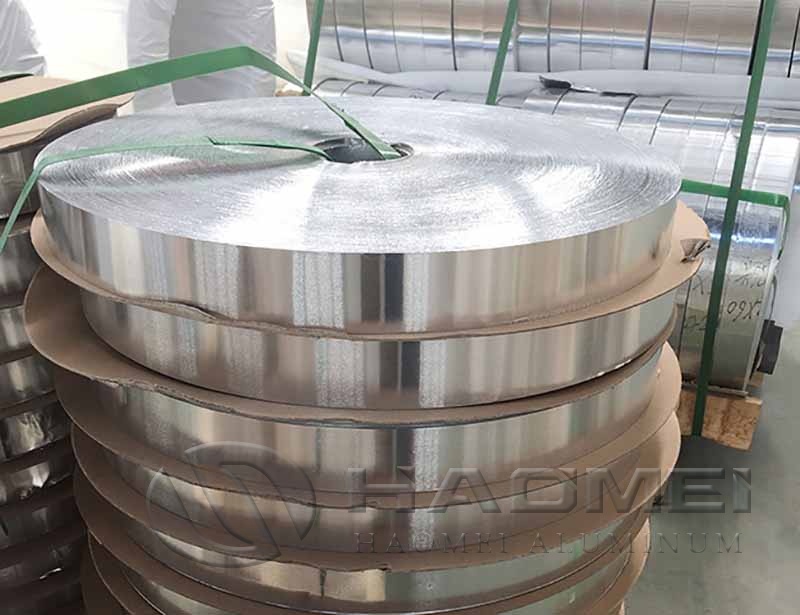
Specify the edge as a measurable requirement, not as the vague phrase smooth edge. A workable technical requirement includes edge type, burr limit, inspection method, sampling frequency, and disposition of edge damage.
| Edge-control item | What to specify | Why it matters |
|---|---|---|
| Slit-edge condition | Deburred or controlled slit edge, with no sharp fins or loose slivers | Protects interlayer insulation during winding. |
| Burr height | Maximum burr height in micrometers, agreed to the insulation system | Prevents ambiguous acceptance decisions. |
| Edge cracks | No visible cracks, splits, or feathered edges at agreed magnification | Reduces breakage during bending and coiling. |
| Edge profile | State acceptable rollover and which side faces insulation | Ensures consistent winding orientation. |
| Cleanliness | No loose aluminum particles, moisture, or objectionable oil | Avoids contamination and localized electrical stress. |
Do not set a universal burr value without considering insulation thickness and winding tension. A thin polymer film requires a more restrictive limit than heavy paper insulation. Ask the winding operation to provide insulation type, nominal thickness, line tension, bend radius, and whether the edge directly contacts insulation.
Incoming inspection should include a stereomicroscope or calibrated optical method for edge review. Measure burr height at both edges and at multiple positions across the parent coil length. Retain photographs of nonconforming edges with scale reference. A visual check without magnification is not sufficient for thin-gauge material.
Order, Test, and Receive Material Without Surprises
A complete order document prevents conflict between nominal dimensions and functional requirements. State thickness, width, tolerance class, coil inside diameter, maximum outside diameter, coil mass, winding direction, and permitted weld policy. A coil that is electrically compliant but incompatible with the decoiler can stop production.
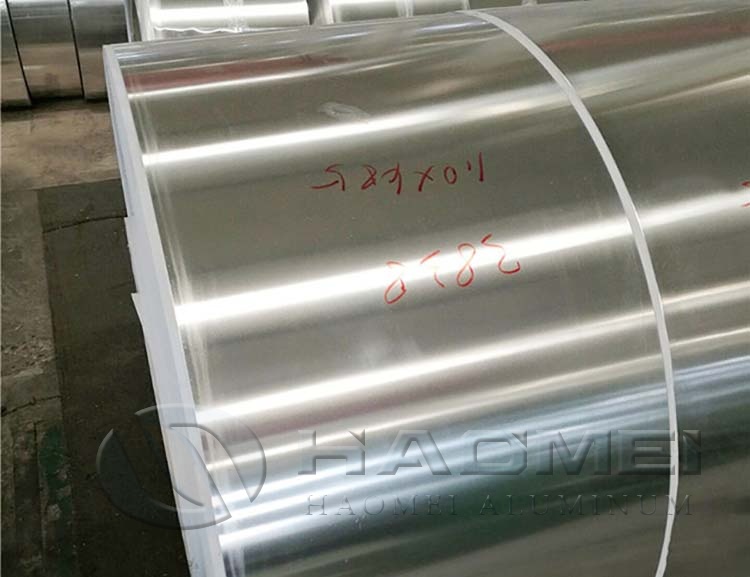
Use this release checklist:
Specify alloy and temper, such as 1060-O or 1070-O, only after confirming the required conductivity and forming behavior.
Define finished thickness and width tolerances, including any thickness measurement location and allowable edge drop.
State a minimum conductivity in % IACS or a maximum resistivity at 20 C. Require the test method and certificate result.
Define burr height, edge condition, surface cleanliness, and permitted coil-end damage.
Confirm coil ID, OD, maximum coil weight, traverse, winding direction, and packaging method.
Require a mill test certificate identifying heat or cast, coil number, chemical composition, dimensions, temper, and conductivity result.
Agree on disposition rules for out-of-tolerance material before shipment.
Recommended incoming tests are listed below.
| Test | Practical method | Acceptance focus |
|---|---|---|
| Thickness and width | Calibrated micrometer and width gauge; sample head, middle, and tail | Compliance with agreed finished dimensions. |
| Conductivity | Eddy-current conductivity instrument or approved laboratory method | Match certificate value and the stated 20 C requirement. |
| Tensile properties | Tensile test per agreed product standard | Confirm soft temper and consistent forming behavior. |
| Burr and edge profile | Optical microscope or profile measurement | Verify insulation-safe edge condition. |
| Surface cleanliness | Visual inspection under adequate lighting; agreed wipe test when required | Identify particles, oil, stains, and scratches. |
| Coil geometry | Measure ID, OD, width, and telescoping | Confirm safe mounting and stable pay-off. |
Conductivity instruments require calibration with certified reference standards and temperature correction when readings are not taken at 20 C. If conductivity is a contractual property, define whether the acceptance result comes from the mill certificate, an independent laboratory, or both.
For applications needing a high-purity electrical conductor, Aluminium Strips should be evaluated by certified resistivity, temper consistency, and slitting quality rather than by appearance or nominal alloy only.
A transformer-ready aluminum conductor combines verified electrical performance with controlled edges and coil geometry. When those requirements are written into the specification and checked at receipt, winding insulation damage, resistance variation, and avoidable line interruptions are substantially easier to prevent.
Original source: https://www.hm-alu.com/a/aluminum-strip-for-transformer-winding.html
Tags:Aluminum Strip For Transformer Winding Electrical Grade Aluminum Strip
Prev: Aluminum Sheet Circle